Some projects I have been working on
SNF Ambizione Project (2022-2026)
Ecological fluid dynamics for habitat creation in river systems
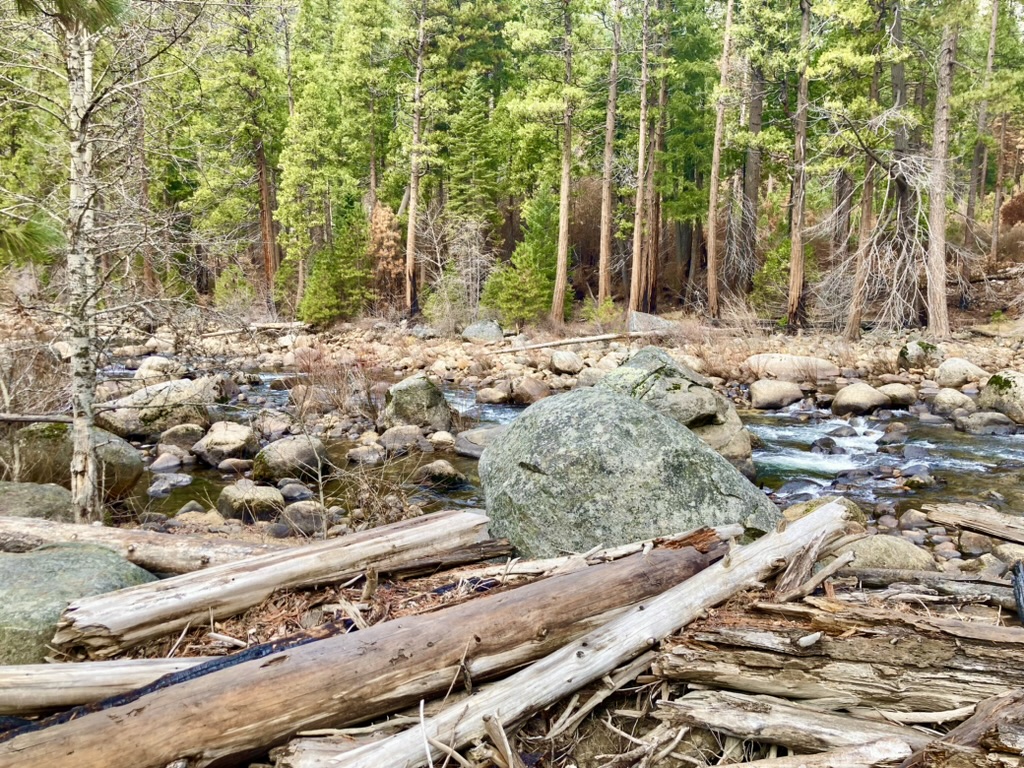
Nature-based solutions (NBS) such as wood and vegetation patches can increase flow heterogeneity, form ecologically beneficial regions with increased nutrient deposition and provide shelter and habitat for aquatic organisms. Recommendations for the relevant flow structures governing aquatic organisms’ behavior exist, but high-resolution flow measurements of the flow and wake (region with reduced flow) structures of different wood patches are missing, leading to a sub-optimal design of restoration measures. The systematic investigation of how wood patches alter flow and particle transport dynamics and how to optimize the design regarding habitat creation is unexplored.
The project represents the next step in the longer research vision to advance the field of ecological fluid dynamics to improve our understanding of river systems and to design the most effective river restoration strategies, where physical and ecological considerations will – in tandem – play a central role. A combined approach of physical model and field tests will be used to answer the following three research questions:
- What are the governing flow and wake structures of NBS that maximize habitat creation?
- How do NBS affect suspended particle (i.e., plastics vs. nutrients or organic matter) deposition processes?
- How do fish and benthic macroinvertebrates respond to NBS?
Project members and partners
- Felix Broß (doctoral student at IFD, ETH Zurich)
- Isabella Schalko (PI, doctoral supervisor)
- Filippo Coletti (ETH doctoral supervisor)
Results
- Compared to channel-spanning logjams, a lateral gap reduces backwater rise, but increases local shear stress and erosion potential (Schalko et al. 2023)
- Log-scale turbulence generated by the logjam persists in the wake for approximately 20 log diameters downstream of logjam (Schalko et al. 2023)
FOEN Hydraulic Engineering and Ecology (2022-2026)
Influence of macro-roughness structures on flood protection in rivers
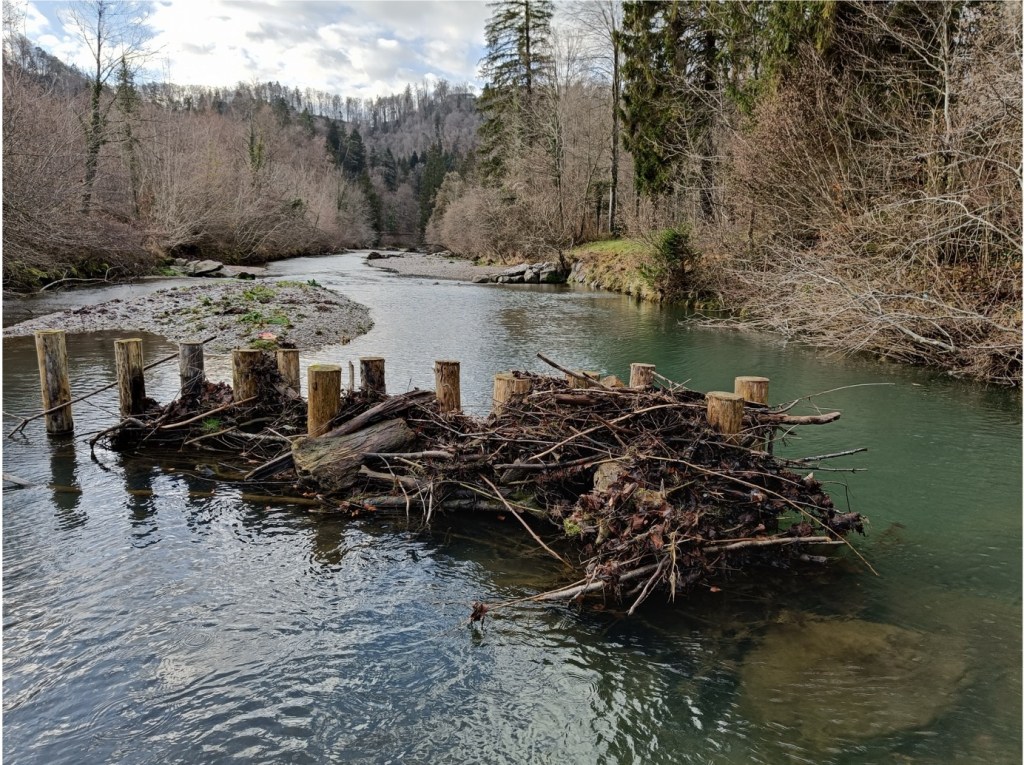
Photo: S. Speltoni, Töss River
Macro-roughness elements such as boulders, engineered logjams, or rootwads can create morphological and flow heterogeneity to create and improve habitats. Their placement in the river reach, as well as their shape and geometry affect local flow and morphological structures. Besides improved ecological conditions these measures may as well have an impact on flood protection issues due to increased backwater rise or local scour. In this project, a doctoral research project will analyze the effects of different macro-roughness structures on flow conditions and riverbed morphology using laboratory and field studies. Laboratory experiments will be conducted focusing on different placement, width, submergence and porosity of wood structures and boulders. The field measurements will focus on flow velocities and riverbed morphology at selected macro-roughness elements in rivers in Switzerland. The aim is to contribute to an improved understanding of the flow-bedload-structure interactions in rivers and to enable the robust design of macro-roughness elements, while considerin the trade-off between river restoration and flood protection.
Project members and partners
- Simone Speltoni (doctoral student at VAW, ETH Zurich)
- Isabella Schalko (doctoral supervisor)
- Volker Weitbrecht
- Robert Boes (ETH doctoral supervisor)

MIT MISTI Germany (2022)
Hybrid Strategies For Stream Restoration
This project was a collaboration between the Institute for Modelling Hydraulic and Environmental Systems (IWS) and the Nepf lab at MIT. The goal was to evaluate if and how the placement of large wood in rivers may reduce river bed clogging, i.e., the infiltration of fine sediment into the gravel bed. This was explored using a combination of field and flume experiments.
Project members and partners
- Sebastian Schwindt (IWS)
- Stefan Haun (IWS)
- Maria Ponce (IWS)
- Heidi Nepf (MIT)
- Simone Lassar (MIT)
- Isabella Schalko (MIT Affiliate)
Results
- The field tests showed that the placement of large wood in the fish bypass at the Inn River (Germany) can reduce riverbed clogging (Schwindt et al., 2023)
SNF Early Postdoc Mobility Fellowship (2019-2020)
Hydrodynamic and morphologic processes associated with wood placements
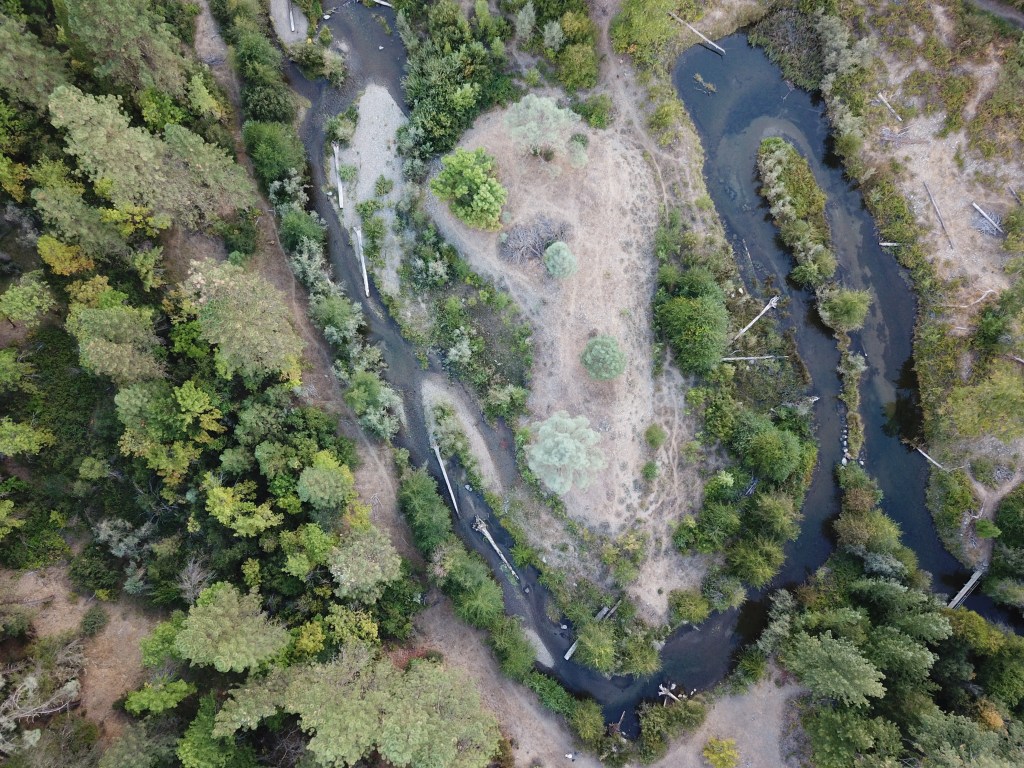
Photo: D. Bandrowski (Yurok Tribe)
Numerous rivers have been confined and are eco-morphologically impaired, resulting in an increased demand for river restoration projects. Wood placements are a common and inexpensive measure for river restoration. To plan and evaluate river restoration projects including wood, it is important to understand the interactions between flow, sediment, and wood. Using physical modeling, this project aimed to quantify flow and morphological structures associated with different wood placements.
Project members and partners
- Heidi Nepf (MIT)
- Ellen Wohl (Colorado State University; external advisor)
- Elizabeth Follett (University of Liverpool)
- Isabella Schalko (MIT Postdoctoral Fellow)
Results
- Emergent logs placed at the channel center resulted in ten times higher turbulent kinetic energy compared to submerged logs (Schalko et al. 2021).
- Submerged logs and logs placed at the channel side created a greater velocity deficit and a longer recirculation zone, both of which can increase the residence time in the wake and deposition of organic matter and nutrients. The results demonstrate that variation in log size and degree of submergence can be used as a tool to vary habitat suitability for different fish preferences (Schalko et al. 2021).
- Logjams act as a porous obstruction, generating momentum loss described by an adaptation of the canopy drag model (Follett et al. 2020).
- For logjams with a vertical gap between the jam and the channel bottom, the distribution of flow through and beneath the jam satisfies a two-box, momentum-based model constrained by drag generated in the jam, momentum loss in flow through the lower gap, and net pressure force (Follett et al. 2021).
FOEN (2019)
Bedload continuity and large wood retention at check-dams
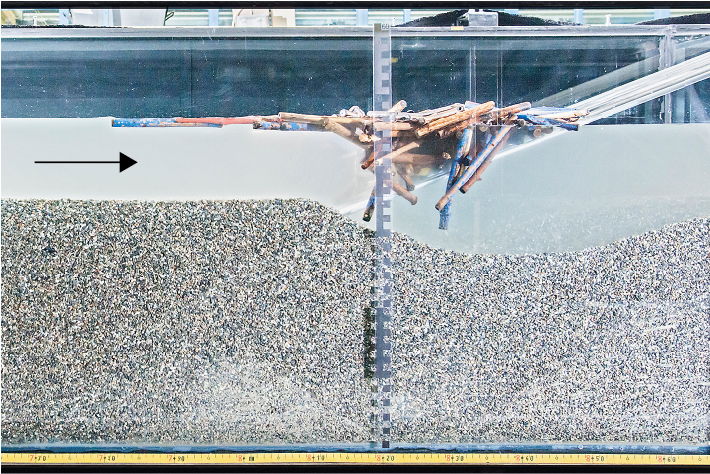
Large wood (LW) transport can increase during floods, leading to accumulations at river infrastructures. To mitigate the potential flood hazard, racks are a common method to retain LW upstream of endangered settlements or infrastructures. The majority of LW retention racks consists of vertical bars and, therefore, disrupt sediment transport. It can be hypothesized that inclined racks reduce backwater rise and sediment disruption, as wood will block the upper part of the rack, thereby increasing the open flow cross-section below the accumulation. Flume experiments were conducted at the Laboratory of Hydraulics, Hydrology and Glaciology (VAW, ETH Zurich) to analyze backwater rise, local scour, and bedload continuity as a function of rack inclination, hydraulic inflow condition, bed material, and LW volume.
Project members and partners
- Virginia Ruiz-Villanueva (VAW, now at University of Bern)
- Fiona Maager (VAW; now at Basler & Hofmann AG)
- Volker Weitbrecht (VAW, ETH Zurich)
- Isabella Schalko (VAW and MIT)
Publications
- Schalko I. & Weitbrecht V. (2022). Wood blockage and sediment transport at inclined bar screens. Journal of Hydraulic Research
- Schalko I., Ruiz-Villanueva V., Maager F., Weitbrecht V. (2021). Wood retention at inclined bar screens: effects of wood characteristics on backwater rise and bedload transport. Water
- Schalko I. (2020). Interaction of wood and sediment at inclined racks. Earth Surface Processes and Landforms
2021
Effect of Water Withdrawal on the Appearance and Sound Level of Waterfalls
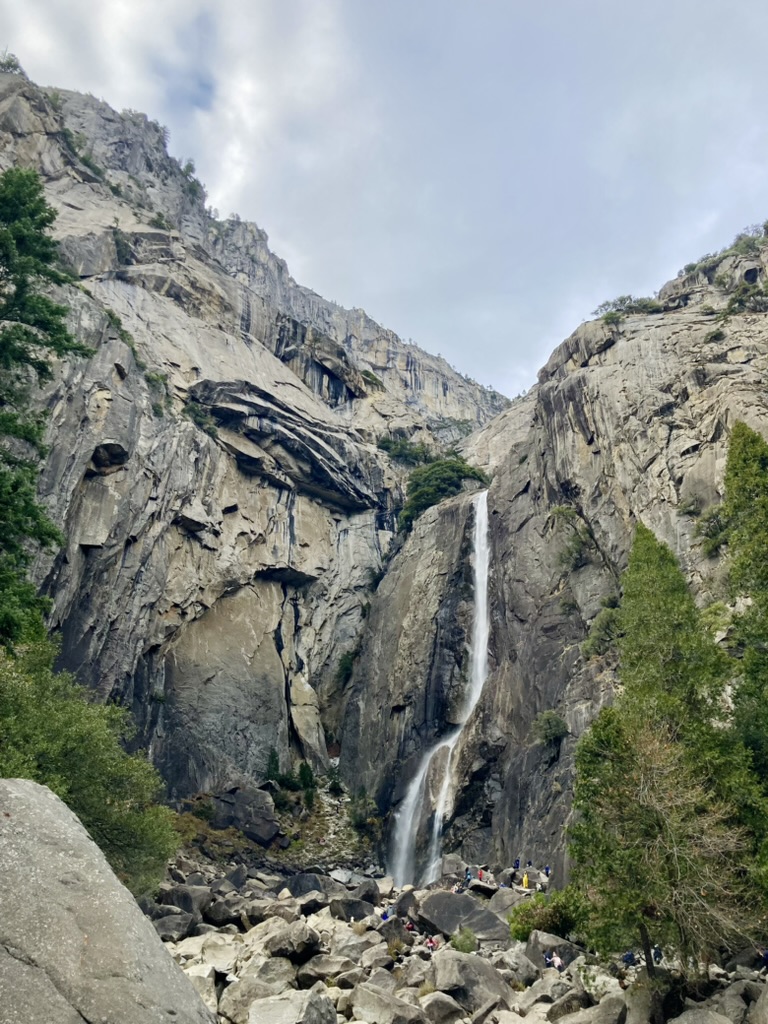
For rivers or streams with waterfalls, water withdrawal for multiple uses can lead to potential conflicts of interest. The question arises to what extent water withdrawal impairs the appearance and acoustics of waterfalls. A data set was analyzed of 15 waterfalls of different morphological types in Switzerland, Austria, and Norway. It comprises discharge measurements as well as photo imaging and sound level measurements. The variations of waterfall appearance and sound level decreased after reaching a threshold discharge value for all investigated morphological waterfall types. For low discharges, visible and acoustics changes were more significant compared to higher discharges. Acoustics changes were less pronounced than visual changes. The acoustics and visual extent of a water withdrawal can be calculated with a novel assessment equation using a normalized discharge. Based on an impact intensity, which is a function of the extent of the water withdrawal and the nonmonetary waterfall value, the selected residual discharge can be evaluated.
Results
- The variation of waterfall appearance and sound level decreases after reaching a threshold discharge value (Schalko and Boes, 2021).
- The extent of a water withdrawal on waterfall appearance and sound level can be described by a normalized discharge (Schalko and Boes, 2021).
Water Falling Still
Poem by Sam Illingworth (December 3, 2021) inspired by our WRR paper
Cascading from rocky peaks,
you plunge into view,
flowing like a fan
into streams
and lakes
and lives.
Fawning at your force
we strive to catch
a breath,
diverting root and branch
to sate
our unquenchable
thirst.
A vision dulled by cataracts,
as we withdraw a trust
not ours to take.
Your sights and sounds
diminished
by the profligacy
of this debt.
FOEN WoodFlow
(2015-2018)
Backwater rise and local scour due to wood accumulation
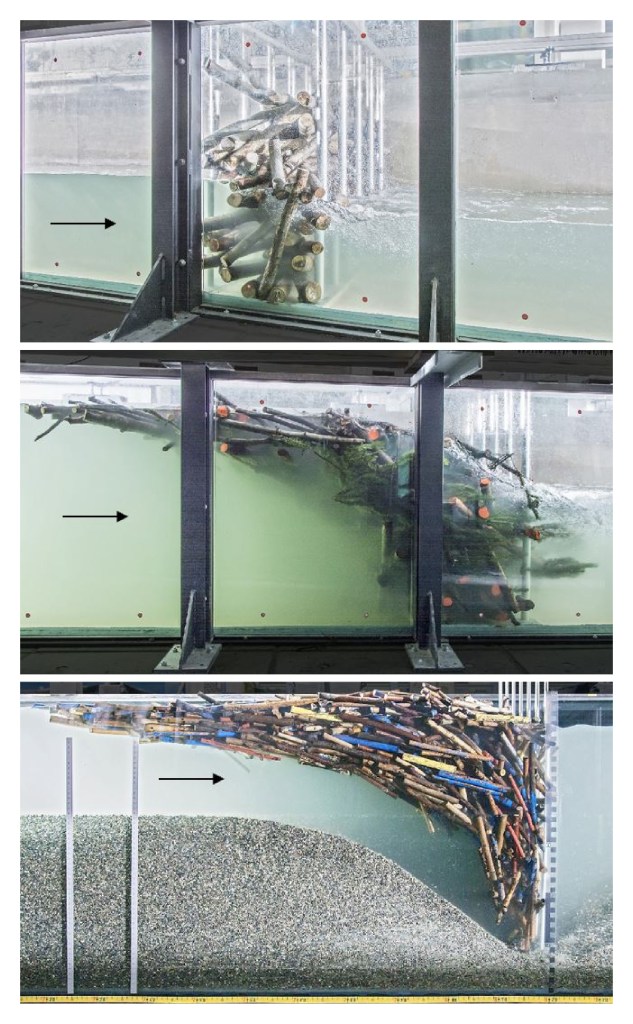
Transported large wood (LW) in rivers may lead to accumulations at natural or artificial obstructions. The hydraulic and geomorphic conditions change due to these accumulations. Backwater rise as well as scour can evolve in the vicinity of such an accumulation. This study was performed for 3 experimental setups, in 2 different flumes and with 3 model scale factors, resulting in ~900 model tests. This project was conducted at the Laboratory of Hydraulics, Hydrology and Glaciology at ETH Zurich in the frame of my doctorate.
- Predefined accumulation – backwater rise: A specific wood accumulation was placed between two rack rows to study the resulting backwater rise. Backwater rise mainly depended on the approach flow Froude number, compactness of LW accumulations, and percentage of organic fine material (branches and leaves). The findings of this study resulted in a design equation to calculate backwater rise due to LW accumulations, contributing to the estimation of the hazard potential assessment of river infrastructures for flood events. Schalko et al. (2018), JHE
- Natural accumulation – backwater rise: The previous setup was adapted to study a natural wood accumulation by removing one rack row and adding wood continuously to the flow upstream of the rack. Focus was put on the resulting backwater rise considering a fixed and mobile bed. The findings were summarized in design equations and allow the estimation of (1) characteristic LW volume generating the primary backwater rise, (2) effect of LW accumulation shape and bed material on resulting backwater rise, and (3) effect of LW volume on backwater rise. Compared to a fixed bed, movable bed reduced backwater rise as the open cross‐section area and thus discharge capacity increased. Schalko et al. (2019), WRR Part I
- Natural accumulation – local scour: Hydraulic model tests were conducted to analyze local scour due to natural spanwise LW accumulations. The flume experiments were conducted with different uniform bed material. The findings allowed for the estimation of local scour depth due to spanwise LW accumulations as a function of unit discharge, sediment diameter, and wood volume. Higher unit discharge, finer bed material, and increasing wood volume led to an increased scour depth. The scour length can be estimated based on the scour depth and a geometrical scaling factor. The longitudinal shape of the cross‐sectional scour depth can be described with a Gaussian normal distribution. Schalko et al. (2019), WRR Part II
 Isabella Schalko